Is Your Norfolk Broadband Deal Poor value? |
The price on your bill is only half the story. Here’s how to check the speed you’re getting, what’s available at your address and whether you can switch. |
A broadband deal can look reasonable on paper and still leave you paying for speed your household doesn’t receive or doesn’t need.
That’s especially worth checking where availability can vary from one address to the next.
A postcode-wide advert can’t tell you exactly what your home can order. The useful comparison starts at your front door.
Here’s a simple broadband value check.
1. Find the paperwork behind the bill
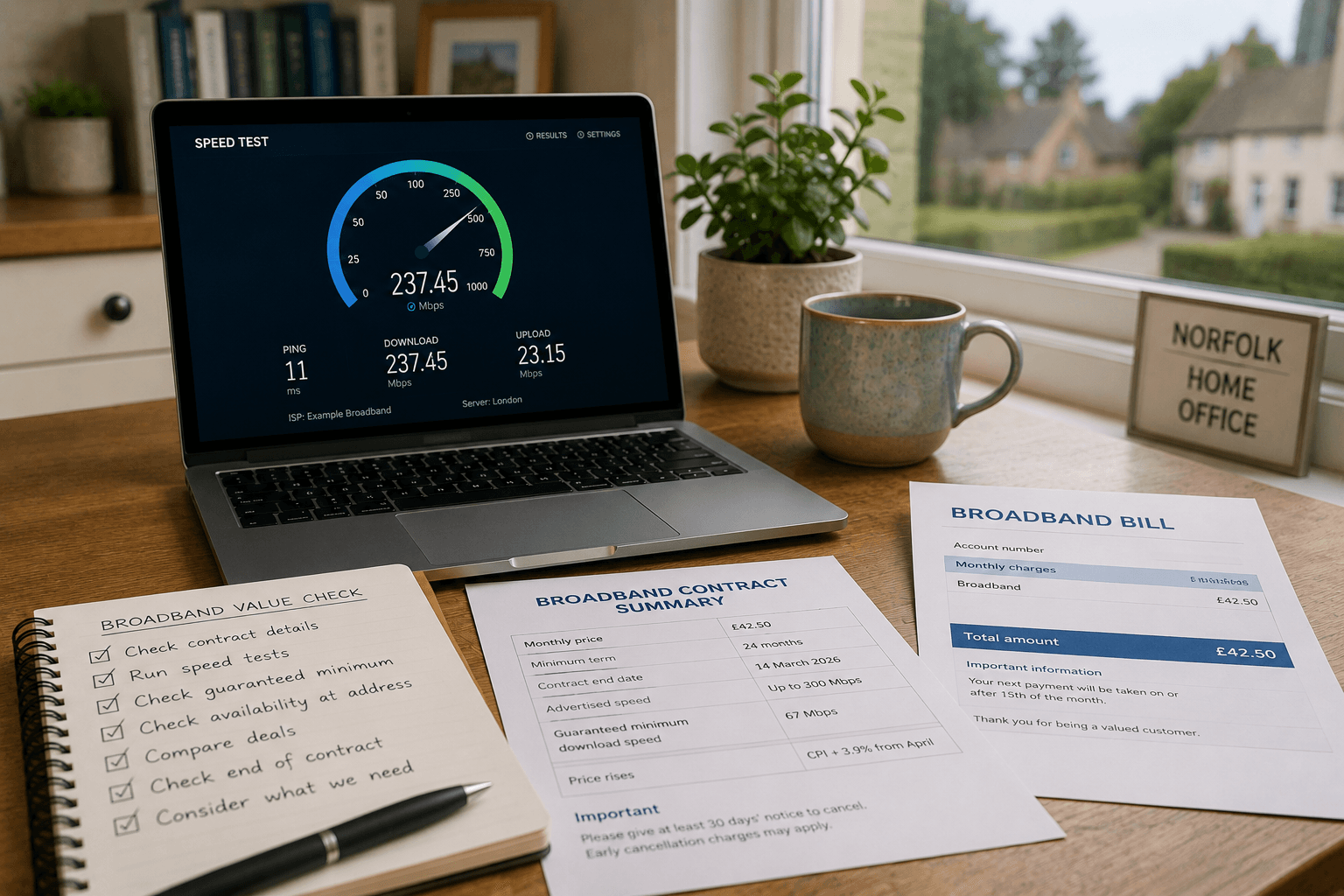
Look for your contract summary, welcome email or online account. Note the monthly price, contract end date, minimum term, advertised download speed, guaranteed minimum speed and any price-rise wording.
Ofcom says residential customers should receive a written contract summary before they’re bound by a deal.
It should include charges, contract length and cancellation arrangements.
If you can’t find yours, ask the provider for the information.
2. Test the service you’re actually receiving
Run several speed tests at different times, including during the evening when more people are online.
Keep a note of the results rather than relying on one unusually good or bad reading.
Compare the results with the personalised guaranteed minimum download speed supplied when you agreed the contract.
The advertised speed is not the same thing as a promise that every device in the house will always reach it.
If your service is persistently below the guaranteed minimum, contact the provider and give it a chance to investigate and fix the problem.
Ofcom’s guidance says you may then be able to leave without paying an early-exit penalty if the issue isn’t resolved.
3. Check what your address can really get
Use Ofcom’s broadband checker with your full postcode and address.
It shows the standard, superfast and ultrafast services predicted to be available there.
Ofcom warns that these are network predictions, and that the result for one address can differ from the wider area.
Then check the relevant provider or network operator using the same address.
Don’t compare a deal advertised for “Norfolk” or a whole postcode district with the service your home can actually order.
Ofcom classifies standard broadband as below 30Mbit/s, superfast as 30–300Mbit/s and ultrafast as above 300Mbit/s.
Those labels help, but the best deal depends on what your household does online.
A home with one light user may not benefit from paying for the fastest package.
A busy home working, streaming and gaming at the same time may notice the difference.
4. Check your end-of-contract position
If you’re out of contract, compare your current bill with the provider’s best available deal and other services available at your address.
Ofcom says providers must tell customers the contract end date, notice period, current and post-contract prices and the best deals available from that provider.
Before cancelling, check for an early-termination charge, a price-rise term and any effect on linked TV, phone or mobile services.
A cheaper headline price isn’t necessarily cheaper once the whole bundle is included.
The fair test isn’t simply
“Can I find broadband for less?”
It’s:
“What can my address receive, what speed am I actually getting, and what am I paying for it?”
Do that check before renewing and you’ll have something much stronger than a tempting advert to use in the conversation with your provider.
If you’ve found a particularly good or poor broadband option at a Norfolk address, tell us the area and what made the difference.
Specific examples could help build a more worthwhile local comparison. |
0 Comments
Join the conversation
Be the first to comment
Share your thoughts above.