
The £1,000 Question: Fan, Air Con Or Heat Pump Cooling What Would You Actually Spend Money On? |
A practical guide to cooling a Norfolk home, from low-cost fixes to permanent systems. |
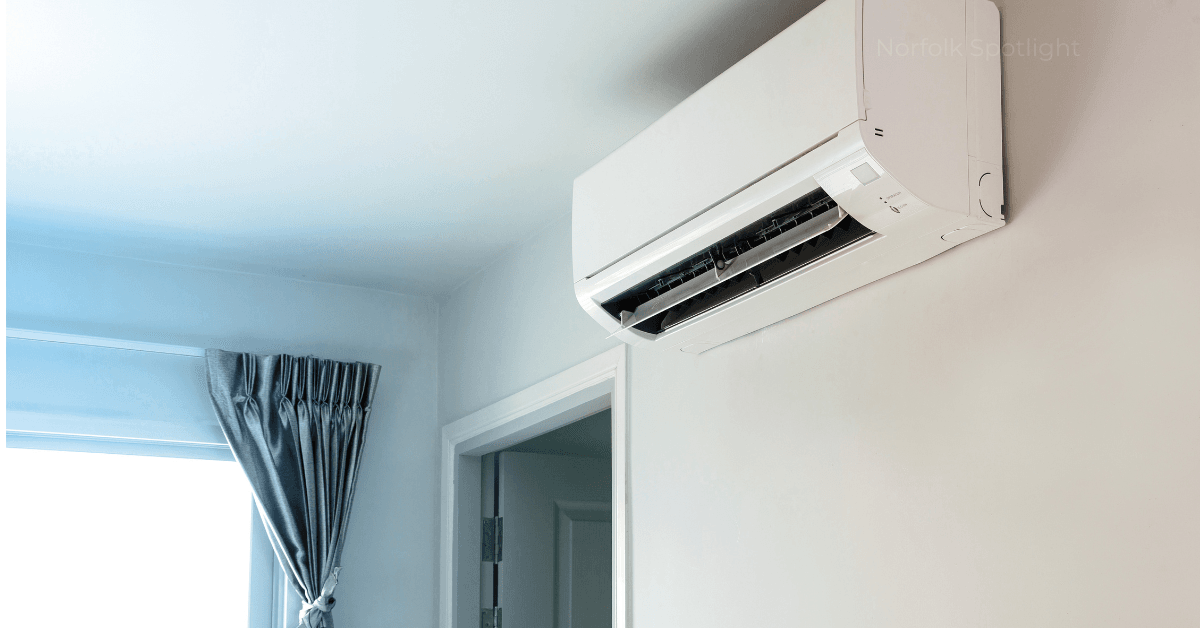
The first hot night is usually a fan night.
By the third, with a warm bedroom, a shut-eyed child and tomorrow’s workday approaching, portable air conditioning starts to look less extravagant.
Then comes the next question: if an air-to-air heat pump can heat as well as cool, is that the smarter long-term buy?
The honest answer is that the best option depends less on the hottest day of the year than on why your home overheats, how often it happens and which rooms you need to make comfortable.
Start with the heat you can stop
Before buying machinery, look at the heat entering the house.
Government hot-weather guidance recommends shading windows, closing blinds or curtains during the day, opening windows when the outside air is cooler and using cross-ventilation where it is safe to do so.
External shading is especially worth considering for large south- or west-facing windows.
That matters in Norfolk homes with sunny upstairs bedrooms, roof conversions, top-floor flats or windows on only one side of the property.
Picture a west-facing bedroom in a Norwich terrace: the room absorbs afternoon sun, the roof space holds the heat and opening the window at 4pm simply lets in warmer air.
A fan may make the person feel better, but it cannot remove the heat stored in the walls, roof and furniture.
If your home is only uncomfortable for a few evenings each summer, shading, night-time ventilation and a decent fan may be the most sensible answer.
What a fan is — and is not
A fan is a comfort device, not an air-conditioner.
It moves air across your skin and can make you feel cooler, but it does not normally lower the room temperature.
That makes it cheap, simple and useful for sleeping, working or sitting in one room.
It is also the option with the fewest installation problems.
There is no hose through a window, no outdoor unit, no drilling and no servicing contract.
But official guidance says electric fans should be used with care when temperatures are below 35°C; above that, they may not protect people from heat and can potentially make things worse.
Spend more on a fan when the problem is personal comfort.
Do not expect it to rescue a room that stays hot long after sunset.
Portable air con: a real step up, with compromises
A portable air-conditioning unit actively removes heat from the room and exhausts it through a hose.
That is why it can provide a much more convincing improvement than a fan during a run of hot days.
The trade-offs are practical.
You need a suitable window arrangement for the exhaust hose, floor space for the unit and somewhere for condensate to go, depending on the model.
Portable units can also be noisy, and cooling one bedroom does not automatically cool the rest of the house.
Indicative UK cost guides put portable air conditioning in the low hundreds of pounds, but availability, model capacity and summer demand can move the price sharply.
Treat any online figure as a buying guide, not a quotation.
Check the room size, noise rating, energy label and whether the window kit is included before comparing prices.
For a Norfolk household that needs reliable cooling in one bedroom, nursery or home office for perhaps a week or two each summer, portable air con may be the sensible middle ground.
It is more effective than a fan without committing to a permanent installation.
Fixed cooling: when comfort is a repeated problem
A fixed split system has an indoor unit connected to an outdoor unit.
It is designed for regular use and can be installed to cool a particular room or several rooms, depending on the system.
Current indicative installation guides put domestic fixed air conditioning broadly in the region of £1,750 to £3,000 or more, with the final price affected by the number of rooms, pipework, access, electrical work and the position of the outdoor unit.
A multi-room system can cost considerably more.
This is the point where the £1,000 question becomes useful.
If your household loses sleep, work time or usable rooms during repeated hot spells, the cost may buy something a fan cannot: predictable cooling where you need it.
If the problem is one warm bedroom for four nights a year, it may be difficult to justify.
Ask for a room-by-room design rather than a generic “whole-house air con” quote.
A good installer should explain what will be cooled, where the outdoor unit will go, how condensate will be managed and what maintenance is expected.
Government guidance recommends using qualified installers and getting more than one quote for heat-pump work.
The heat-pump crossover
Air-to-air heat pumps use similar technology to many fixed air-conditioning systems.
They can provide cooling in summer and heating in winter, so they may be worth considering if you are already replacing electric heating, planning a renovation or want one system to serve both jobs.
But do not confuse them with the air-to-water heat pumps commonly discussed for radiators and hot water.
An air-to-air system generally delivers heating and cooling through indoor fan units; it does not automatically replace a boiler, hot-water cylinder or every radiator in the home.
Energy Saving Trust advises that cooling-capable air-to-air systems may suit homes that still overheat after passive measures, but also notes that there is limited UK data on their performance and savings.
In other words, do not buy one on a promised payback period alone.
The verdict
Spend least first on shading, ventilation and a fan if the overheating is occasional and concentrated in one room.
Consider portable air con if you need a noticeable improvement soon, mainly in one room, and accept the noise and window-hose compromise.
Look at fixed cooling or an air-to-air heat pump when overheating is a recurring household problem, several rooms matter, or you are already investing in a heating upgrade.
At that point, pay for a proper assessment rather than buying the biggest machine available.
The question to ask an installer is not “How powerful a unit can I fit?” It is
“What is causing this home to overheat, and what is the smallest system that will solve it properly?”
Save this comparison before spending money on the next hot-weather fix.
|
0 Comments
Join the conversation
Be the first to comment
Share your thoughts above.